
Yesterday, I tried a new method of cooking burgers after a few years of only making smash burgers. My opinion has been that flattening burgers prioritizes browned bits over thickness, producing better flavor. For people who wanted thicker burgers, my advice has been to just layer multiple smash burgers. You could even put cheese between them, so that’s an additional win for cheeseburger lovers. Smash burgers are also cooked far beyond the minimum safe temperature, which is popular in my house because nobody wants to get an E. coli infection from ground meat.
But I saw a method for cooking thicker burgers that I thought was at least worth trying. So I did. And here, I’m going to tell you about it and give you my quick take.
The Pub Burger Method
I saw this method in a video short, and I don’t have the source1. It might have been called a steak burger, or a pub steak burger, or who knows what. And it involves intense browning of the burger, reduced splatter, thicker, larger burgers, and thorough cooking. Here’s what you do.
- Choose a relatively high-fat ground beef. 80% lean has been my favorite for burgers.
- Form burgers from 1/2 lb of ground beef. Round, even thickness, about 4” in diameter.
- Salt both sides of the burgers.
- Heat a deep stainless steel pot until water droplets dance on the bottom.
- Add a couple of teaspoons of oil to the bottom of the pot, then tilt the pot to coat it (you might want to use your exhaust fan).
- Fit your burgers in the bottom of your pot. Pepper generously.
- Turn heat to medium high (that’s what worked for me, YMMV).
- Leave the burgers alone until you can tell the meat has released from the pan. Tilt the pot or poke a little with a utensil.
- Flip the burgers.
- Brown until they release again.
- Test the internal temperature. It is likely under what you would consider a cooked burger.
- Add a couple of ounces of water, cover the pot, and let the burgers finish at a lower temperature, steaming.
- This phase may take about five minutes. But it will depend on your tolerance for low cookedness. I cooked it to well over 145 degrees. WELL OVER. Which, for me, is not ideal. I’d like exactly 145 degrees.
- Remove, place on bun, serve, eat.
Additionally, I produced some onions and mushrooms for Maggie, because she loves that stuff (it is good).
Mushrooms
- Slice an onion and 12 oz. - 1 lb. of your favorite mushrooms.
- Heat a pan (I like a covered carbon-steel pan for this) until the water dances.
- Add a couple of teaspoons of high-temperature oil (I like avocado).
- Let the pan cool down a little bit.
- Throw in onions and mushrooms. Cover the pan.
- Allow the onions and shrooms to brown on the edges. Keep them moving a little bit.
- Uncover the pan and stir every minute or so. If you can, toss the pan’s contents.
- As you can see, the mushrooms begin to shrink, and the onions soften. Season with salt and pepper to taste, and about 1/2 tsp of thyme.
- Throw in about an ounce of water and a tsp of butter. Cover until the butter melts. (This stage allows some of the flavors that may have stuck to the pan to unstick and soak into the mushrooms).
- Place on extremely low heat (or no heat) until you are ready to serve.
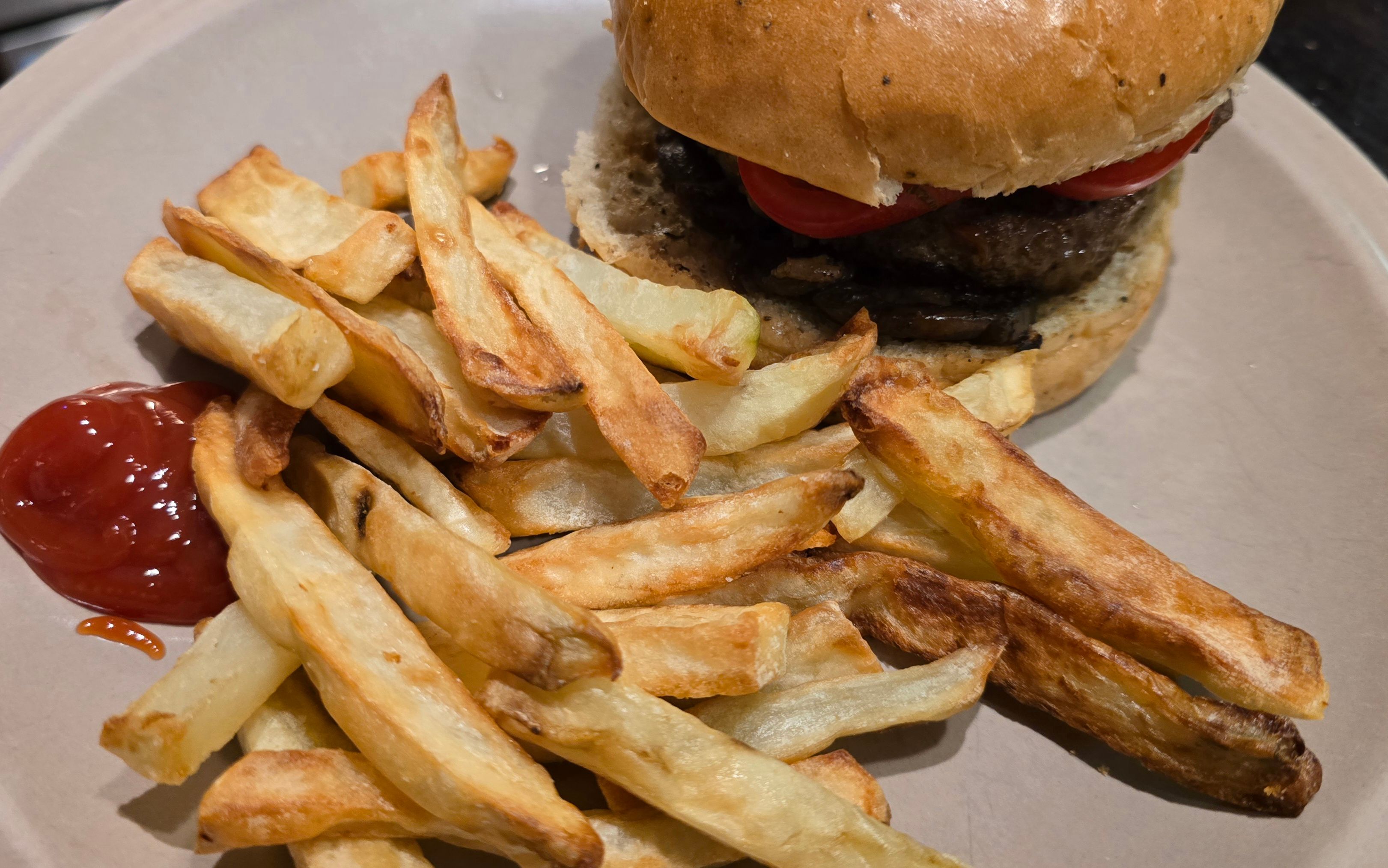
Verdict
Ease of method: 9/10
This was an easy way to cook burgers to the level you like, precisely. The high sides of a stainless steel pot reduce splattering, but don’t eliminate it. You’ll get aerosolized oil in the air, and the odor will still permeate your clothing. But it worked great.
Taste: 8/10
The heavily browned surface crust was excellent. The inside of the burger will have the taste of the quality ground beef you bought. I gave it just a 8/10 because I think you can attribute about that much responsibility to the method vs. the meat itself. Also, I’m comparing it to smash burgers. If you believe your burger is a great platform for the condiments, you’re not focusing on the burger itself.
Addressing the condiment situation, this thick burger is best suited to thin slices of onion and other very strongly flavored condiments.
Maggie didn’t like the large amount of pepper I used, but the salt and pepper on the surface of the burger were a welcome flavor contrast.
Texture: 6/10
The texture was not my favorite. I overshot the target temperature, which did push the burger to the dry side. If you make this burger, consider being very careful to hit your desired doneness. I’m just not a fan of a thick patty of completely cooked ground beef. Smash burgers do get dried out, but the high heat kind of liquifies what it doesn’t brown, so they have a different sort of juiciness. But as soon as you go thicker, it feels like you have to ease back on the cooking. Maybe way back.
Cleanup: 9/10
The bottom of the pot was relatively nonstick after heating, oiling, and then slightly cooling. The sides took a little scrubbing, but not much. The fond could have been used for something – maybe combined with the mushrooms for flavor.
Final Verdict: 8/10
I’d make these again, but given the choice, it’s still smash burgers.
-
Reels, shorts, TikToks (I don’t care what you call them) are hard ot track down once you’ve seen them, and often disappear when you reload a page on Facebook. It’s a disservice to creators, but the platforms don’t care about their success. When things were more stable, you could easily look back on the videos you watched and provide a link. Now it takes so much effort to do that; it’s often not worth it. So, sorry, person who made a video about this technique. ↩


Leave a comment